

 For collectors during the boom of the 1980s, few sights were more drool-inducing than a huge stack of 1978 Topps baseball cards.
It wasn’t that the design blew us away — every year after 1982 offered up at least one set among the Big 3 that looked better.
It also wasn’t due to some sense of nostalgia, longing for the days when Topps ruled the roost alone and long-lost legends roamed the diamond. Except for a very few holdout curmudgeons, everyone loved the newfound variety and wanted more, more, more.
No, aside from a couple of future Hall of Famers — Brooks Robinson and Lou Brock — the heroes we collected in the early 1980s weren’t much different than the ones we had chased in 1978. Notable exceptions were young players who entered mid-career as the hobby blossomed.
As it turned out, many of those standouts made their cardboard debuts in the 1978 Topps set, which positioned it as a prime target for our latent treasure hunts.
You just never knew when Ken Clay or Jerry Tabb might take that step up to superstardom, after all.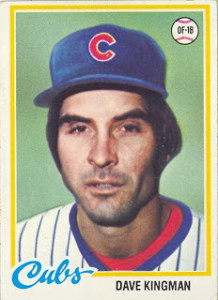
Scripted for Success
Topps, of course, was already a superstar in the world of baseball cards in 1978. In fact, they were still the only player on the field, though, unknown to most collectors, forces were in play that would change all that within three years.
But in that year that saw three Popes, Topps could have slopped together any old design and we would have continued to worship at their cardboard altar. Instead, they rolled out an understated motif that belied the garish, disco-fueled era in which it was produced.
Each card front is dominated by a large full-color photo of the player surrounded by thin color piping. In the lower left corner, the team name is printed in script lettering, usually in one of the club’s colors. The player’s name is printed in black block letters in the bottom white border and his position appears in a small baseball in the upper righthand corner of the photo.
Even the usual Topps white border was a tad slimmer than usual, leaving the cards with a simple, uncluttered look that kept our focus on the players.

The only other design elements — aside from the “special” cards listed below — were All-Star shields and Rookie All-Star trophies for players so honored.
Had Topps been able to ratchet up its photo quality to, say, 1983 levels, the 1978 set might be considered a classic. Without the push of competition, however, The Old Gum company “treated” us to tons of of head shots and posed “action” stills, dingy and/or grainy images, and at least two of the most comically bad airbrushing treatments of all time. Greg Minton (#312) would have been at home in the 1953 Topps set, and poor old Mike Paxton (#216) looks like he stepped into one of those horrid boardwalk cutouts where you can be immortalized on Polaroid stock as a mermaid or a pig farmer for your kids’ delight.
“Step right up — YOU can be the next cartoon player for the Boston Red Sox!”
There is no airbrushing on card backs, but there is plenty in the orange, blue, and gray design to let you know you’re looking at a Topps issue.
Each horizon tal back starts with the card number inside a small blue box the upper righthand corner. Next to that are two lines of biographical and vital information, and beneath that is the heart of the thing: complete major and minor league statistics. Where space allows, Topps includes a paragraph of text detailing career highlights under the stats block.
The bottom band shows the team name, player’s name, and position.
Topps tried to encourage interactions with their ’78 issue through a feature dubbed “Play Ball” and situated in a rectangle next to the player stats. Each card features one baseball “play” — fly out on Von Joshua’s #102, for example — allowing two players to work through a full nine-inning game if they so desired.
In an unusual fit of humility, the Topps logo doesn’t appear anywhere on their 1978 topps cards. Maybe it was actually hubris — “We’re the ONLY base ball cards out there” — but I prefer to think TCG decided not to muck up their design by shoehorning in a piece of branding where it doesn’t really fit.
Rookie Stars that Really Were
Of course, in the rookie-crazed hobby of the 1980s, design hardly mattered. If there were a big-time first-year player, or even the promise of rookie gold, we were in.
By the time the hobby really started to boom in the mid 1980s, the 1978 Topps had already been marked as a repository of known treasure and potential treasure.
Eddie Murray finished second in AL MVP voting in both 1982 and 1983, and he had won the Rookie of the Year award in 1977. His moody personality may have turned off some fans and collectors, but we still wanted his #36 RC in the ’78 set.
In 1984, the  Detroit Tigers unseated Murray’s Baltimore Orioles as both American League and World Series champions, led by a bevy of stars entering their prime years. Among those were 1978 Topps rookie-card standouts Jack Morris (#703), Lou Whitaker (#704), and Alan Trammell (#707).
This was the era of multi-player rookies, and Trammell shared his debut pasteboard with the talented but fragile Paul Molitor, who teased fans with flashes of brilliance throughout the Eighties but couldn’t seem to stay on the field for more than a few games at a time.
A move out of Milwaukee and into the DH slot later in his career helped Molitor shore up his health and put up the numbers that landed him in the Hall of Fame in 2004. In one of the greatest HOF oversights, Trammell remained on the Cooperstown outsiders list for far too long. He’s in now, though, and their combined RC depicts more future talent than any piece of cardboard could rightfully expect to embody.
Meanwhile, two-time NL MVP Dale Murphy was back for his second stint as a Rookie Catcher, sharing space this time around with Detroit signal caller Lance Parrish on #708.
And these were just a few of the guys we knew were stars by the middle of the 1980s. The 1978 Topps set was a well that we went back to again and again in 
search of rookie cards of the guys who carried their teams in the new decade, and our pail seldom came up dry.
Among the other rookies who made a splash, at least for awhile, between their issue in 1978 and the dawn of the 21st Century were: Art Howe (#13), Floyd Bannister (#39), Mitchell Page (#55), Willie Hernandez (#99), Dave Rozema (#124), Steve Henderson (#134), Warren Brusstar (#297), Rick Langford (#327), Tony Scott (#352), Mario Soto (#427), Jim Clancy (#496), Donnie Moore (#523), Bob Knepper (#589), Thad Bosley (#619), Moose Haas (#649), and Julio Cruz (#687).
Aside from Howe, other manager “rookie cards” were Joe Altobelli (#256), Vern Rapp (#324), and Dave Garcia (#656).
At 726 cards, the one-series 1978 Topps set was their largest issue since 1972, and they needed every inch of that cardboard to fit in all the promising rookies.
Of course, first-year players were NOT the main focus of Topps sets in the 1970s, despite the evidence presented here.
Among the future Hall of Famers showing their mugs in the 1978 set are Pete Rose (#20), Lou Brock (#170), Reggie Jackson (#200), Mike Schmidt (#360), Nolan Ryan (#400), Tom Seaver (#450), Steve Carlton (#540), and Brooks Robinson (#4) — a record-breaker that is his last ap pearance in a regular-issue set.
Diff’rent Strokes
Even back in 1978, collectors wanted variety beyond the star-and-11-commons wax pack experience that was the norm. Topps was glad to oblige, treating us to the typical run of subsets and special cards.
Among the off-standard offerings were:
- Record Breakers – #s 1-6
- Team Cards/Checklists – one for each team, starting with the Chicago White Sox at #66
- Checklists – starting at #74; six in total
- Manager Cards – one for each team, starting with Darrell Johnson at #79
- League Leaders – #s 201-208
- Playoff and World Series Highlights – #s 276-277
- Multiplayer Rookie Cards (by position) – #s 701-711
The ’78 set also reintroduced collectors to another “special” concept: double prints.
Because Topps expanded its offering from 660 cards in 1977 to 726 in 1978 but kept the size of its printing sheets the same at 132 cards, the set didn’t fit evenly on  its six sheets. As a result, 66 cards were issued twice as often as their brethren, with double prints running the gamut from superstars like Rose and AL Cy Young winner Ron Guidry (#135) to lesser lights like Darold Knowles (#414).
If you prefer